Best Time to Post on Twitter (X): A Complete Guide for Maximum Engagement
- AI Tips WEEKLY TOP
Anna Anna
- 0
- 105 minutes read
Introduction
If you’ve ever published a great post on Twitter (X) only to receive very little engagement, you’re not alone. Many creators, businesses, and marketers focus heavily on content quality but overlook another important factor: timing.
While there is no magic hour that guarantees viral success, posting at the right time can significantly improve your chances of reaching more people and generating stronger engagement. Because Twitter is built around real-time conversations, users often interact with content shortly after it is published. This makes timing more important on X than on many other social media platforms.
The challenge is that there is no universal answer to the question, “What is the best time to post on Twitter?” Different audiences have different habits, industries attract different users, and engagement patterns vary across regions and time zones.
However, by understanding how Twitter posting times affect visibility and learning how the platform distributes content, you can dramatically improve your results.
In this guide, you’ll learn:
- The best time to post on Twitter (X)
- The best day to post on Twitter
- How posting times affect engagement
- How to find the best posting schedule for your audience
- Common mistakes that reduce reach and visibility
Whether you’re building a personal brand, growing a business account, or developing a Twitter marketing strategy, understanding when to post on Twitter can help you maximize your efforts.
Table of Contents
Why Posting Time Matters on Twitter (X)
Many social media experts debate whether timing still matters in an algorithm-driven world. While content quality remains the most important factor, timing continues to play a significant role in determining how much visibility a post receives.
The reason is simple: the Twitter algorithm uses early engagement signals to decide whether content deserves wider distribution.
How the X Algorithm Works
When you publish a tweet, X does not instantly show it to every follower. Instead, the platform gradually distributes content and evaluates how users respond.
The algorithm looks at signals such as:
- Likes
- Replies
- Reposts
- Bookmarks
- Profile visits
- Time spent viewing content
If a tweet generates positive engagement shortly after publication, the algorithm becomes more confident that people find the content valuable.
As a result, it may show the tweet to:
- More followers
- People who interacted with similar content
- Users who do not currently follow your account
This is why understanding the best time to tweet can directly influence reach and visibility.
Why Early Engagement Matters
The first hour after publishing is often the most important period for a tweet.
Think of it as a testing phase.
The platform wants to determine whether your content deserves additional exposure. If people quickly engage with your post, the algorithm receives a strong signal that the content is worth promoting.
However, if your audience is asleep, working, or simply inactive when you publish, your tweet may struggle to gain traction—even if the content itself is excellent.
This is one reason why Twitter audience engagement often varies dramatically depending on posting time.
A well-written post published when your audience is active can outperform a stronger post published when very few people are online.
The Relationship Between Timing and Reach
Many creators assume that timing alone can increase Twitter reach.
In reality, timing acts as an amplifier.
Imagine two identical posts:
- Post A is published when most followers are active.
- Post B is published when most followers are offline.
Post A is far more likely to receive immediate likes, replies, and reposts.
Because of this early engagement, the algorithm may continue distributing Post A to a wider audience.
Meanwhile, Post B may never receive enough engagement signals to gain momentum.
This is why many successful creators carefully monitor Twitter posting times and continuously test new schedules.
Why Different Audiences Have Different Posting Times
One common mistake is assuming that a generic study applies to every account.
For example:
- A B2B audience may be most active during work hours.
- A gaming audience may be most active late at night.
- A finance audience may engage heavily during market hours.
- An international audience may be spread across multiple time zones.
Because of these differences, the best posting schedule for Twitter can vary significantly from one account to another.
General recommendations provide a useful starting point, but your own analytics should always guide long-term decisions.
Timing Is Important, But Content Is Still King
It’s important to remember that even the best time to post on X cannot save poor content.
A weak post published at the perfect hour will still struggle.
On the other hand, valuable content that educates, entertains, or inspires people can often perform well even outside peak engagement windows.
The most successful Twitter marketing strategies combine:
- High-quality content
- Strong posting consistency
- Active audience engagement
- Smart timing
When these elements work together, growth becomes much easier and more sustainable over the long term.
Best Time to Post on Twitter (X)
One of the most common questions marketers and creators ask is: “What is the best time to post on Twitter?”
While there is no single answer that works for every account, studies and user behavior patterns consistently show that certain time periods tend to generate higher engagement than others.
These time slots align with moments when users are naturally more active, making them ideal opportunities to increase Twitter reach and maximize visibility.
If you’re just getting started, the following Twitter posting times provide a strong foundation for testing and optimization.
Best Overall Time to Post on Twitter
While the best time to post on Twitter varies depending on your audience and industry, several time slots consistently perform well across most accounts. These periods align with times when users are actively checking their feeds, participating in conversations, and engaging with content. If you’re unsure when to post on Twitter, start with the following schedule and adjust based on your analytics.
8:00 AM – 10:00 AM
Morning hours are often considered one of the best times to tweet.
Many users begin their day by checking social media, reading news updates, catching up on industry trends, or browsing content before work.
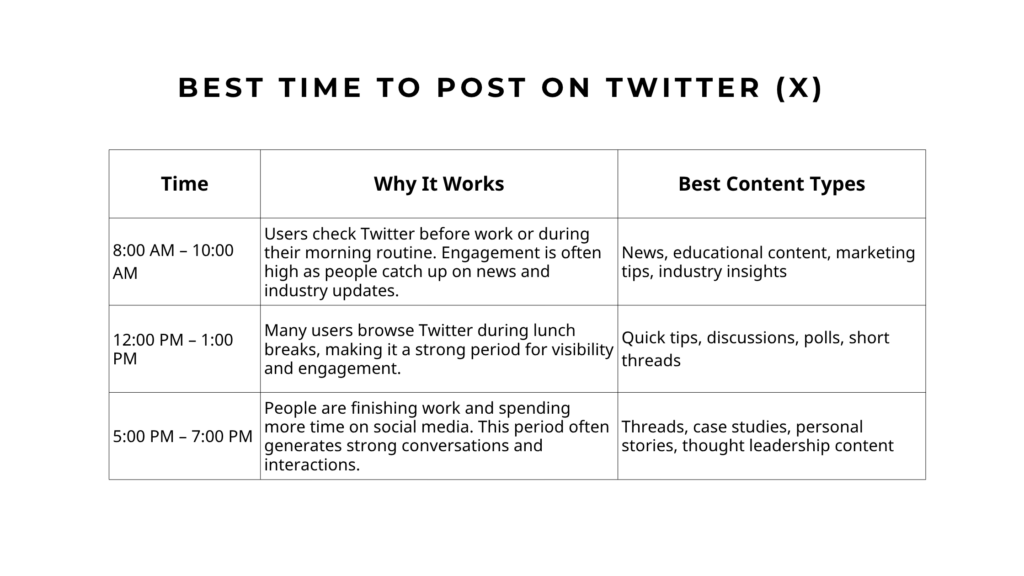
During this period, people are generally looking for information rather than entertainment, which makes it an excellent time to publish:
- Educational content
- Industry insights
- News updates
- Marketing tips
- Business advice
- Professional discussions
For B2B brands and personal brands, morning engagement can be particularly strong.
Many professionals use X as part of their daily routine, making this one of the most reliable posting windows throughout the week.
Why Morning Posts Perform Well
There are several reasons why morning Twitter audience engagement tends to be strong:
First, competition is often lower compared to later hours when more creators are actively publishing content.
Second, users are more likely to have uninterrupted time to read and engage with valuable posts.
Third, morning engagement can continue building throughout the day, giving tweets a longer lifespan.
If your audience consists primarily of professionals, entrepreneurs, marketers, or business owners, morning posting should be a key part of your Twitter marketing strategy.
12:00 PM – 1:00 PM
Midday is another highly effective posting window.
During lunch breaks, many people take a short break from work and spend time browsing social media.
This creates a natural opportunity to reach users when they are relaxed and more likely to engage with content.
Popular content formats during this period include:
- Quick tips
- Industry updates
- Opinion posts
- Short threads
- Discussion starters
Unlike morning users who may be focused on information gathering, midday users are often more willing to participate in conversations and leave replies.
Why Midday Engagement Is Strong
One reason this period performs well is accessibility.
People may not have time to read long articles or watch videos during work hours, but they can easily scroll through Twitter during lunch.
This makes concise and valuable content particularly effective.
For creators trying to improve Twitter audience engagement, midday often provides an excellent balance between visibility and interaction.
5:00 PM – 7:00 PM
Evening hours represent another major engagement peak.
After work or school, people generally have more free time to consume content, reply to posts, and participate in discussions.
This is often one of the best times to post on X if your goal is conversation and community building.
Content that tends to perform well during evening hours includes:
- Threads
- Personal stories
- Case studies
- Thought leadership content
- Industry debates
- Long-form insights
Because users have more available time, they are often willing to engage with deeper content than they would during a busy workday.
Why Evening Posts Generate More Interaction
Evening users are typically less distracted by professional responsibilities.
As a result, they are more likely to:
- Read entire threads
- Leave detailed comments
- Share content with others
- Join ongoing conversations
This increased activity can provide the early engagement signals needed for the algorithm to expand your content’s reach.
For many creators, evening posting is one of the most effective ways to increase Twitter reach organically.
Is There a Universal Best Time to Post on X?
Not exactly.
The best time to post on X depends on several factors:
- Your industry
- Audience demographics
- Geographic location
- Time zones
- Content type
For example:
A marketing audience may be highly active at 8 AM.
A gaming audience may be more active after 8 PM.
A global audience may engage throughout the day.
This is why generic Twitter posting times should be treated as starting points rather than permanent rules.
The most successful creators continuously test and refine their schedules.
The Best Posting Schedule for Twitter
If you’re looking for a simple schedule to start with, consider the following approach:
Morning Post
8:00 AM – 9:00 AM
Share educational content, industry insights, or news-related updates.
Midday Post
12:00 PM – 1:00 PM
Publish discussion-based content, questions, or short value-packed posts.
Evening Post
5:00 PM – 7:00 PM
Share threads, personal experiences, case studies, or thought leadership content.
This schedule allows you to reach users during three of the most active periods of the day while gathering valuable engagement data.
Why Testing Matters More Than Following Studies
Many articles claim to reveal the best day to post on Twitter or the perfect posting schedule.
While these studies can provide useful guidance, they cannot fully account for your unique audience.
The only way to identify your true optimal schedule is through testing.
Track:
- Impressions
- Likes
- Replies
- Reposts
- Profile visits
- Follower growth
Over time, patterns will emerge that reveal when your audience is most active.
Those insights will always be more valuable than any generic recommendation.
By combining proven Twitter posting times with audience-specific testing, you can build a posting schedule that consistently generates stronger engagement and long-term growth.
Best Days to Post on Twitter (X)
Finding the best time to post on Twitter is important, but timing is only one part of the equation. The day you choose to publish can also influence visibility, engagement, and reach.
User behavior changes throughout the week. Work schedules, weekend activities, and daily routines all affect how people interact with content.
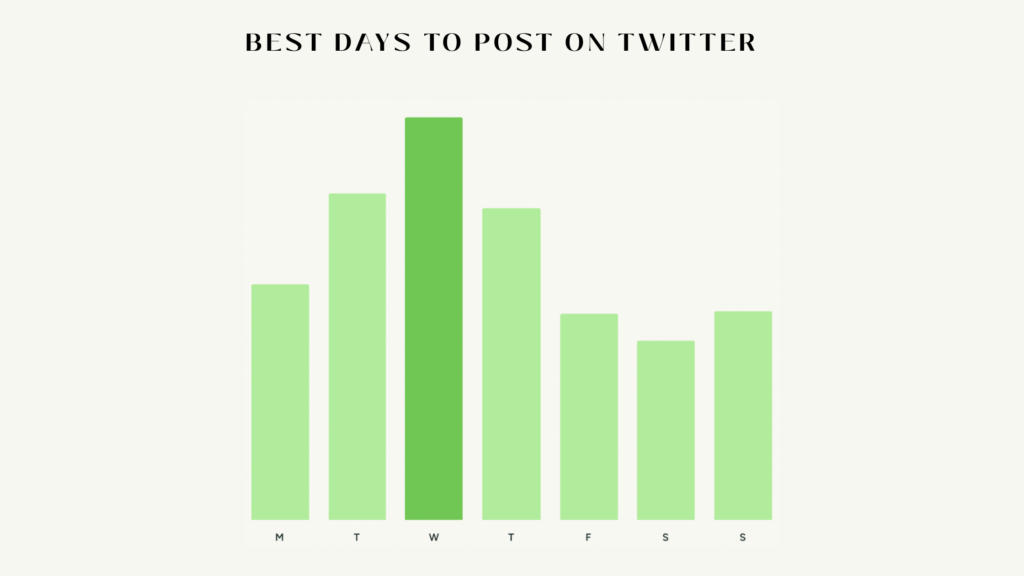
As a result, some days naturally generate higher Twitter audience engagement than others.
Let’s look at how each day typically performs and what type of content works best.
Monday
Monday is often a strong day for professional content.
Many people return to work after the weekend and spend time catching up on industry news, business updates, and educational resources.
This makes Monday an excellent day to publish:
- Industry insights
- Business content
- Marketing advice
- Educational posts
- News commentary
However, competition can also be high because many creators become active after the weekend.
Best Time to Post on Monday
- 8:00 AM – 10:00 AM
- 12:00 PM – 1:00 PM
Morning content tends to perform particularly well because users are actively looking for information to start their week.
Tuesday
Many social media studies identify Tuesday as one of the best days to post on Twitter.
By Tuesday, people have settled into their work routines and are actively engaging with content throughout the day.
Engagement levels are often higher because users are more focused and consistent in their online activity.
This is a great day for:
- Threads
- Educational content
- Thought leadership posts
- Case studies
- Professional discussions
Why Tuesday Performs So Well
Tuesday often combines:
- High audience activity
- Strong engagement rates
- Consistent user behavior
For many creators, Tuesday represents one of the most reliable opportunities to increase Twitter reach.
Best Time to Post on Tuesday
- 8:00 AM – 10:00 AM
- 12:00 PM – 1:00 PM
- 5:00 PM – 7:00 PM
Wednesday
Wednesday is another top-performing day.
Many marketers consider it one of the strongest days for Twitter posting times because engagement tends to remain high across multiple industries.
Users are fully engaged in their weekly routines, making them more likely to interact with valuable content.
This day works especially well for:
- Marketing content
- Technology discussions
- Business insights
- Educational threads
Best Time to Post on Wednesday
- 8:00 AM – 10:00 AM
- 12:00 PM – 1:00 PM
- 5:00 PM – 7:00 PM
For many accounts, Wednesday generates some of the highest engagement rates of the entire week.
Thursday
Thursday continues the momentum built earlier in the week.
Many audiences remain highly active, and engagement levels often stay strong.
This is an excellent day to publish:
- Long-form threads
- Detailed guides
- Case studies
- Expert opinions
If your goal is to position yourself as an authority in your niche, Thursday can be a great day to share deeper insights.
Best Time to Post on Thursday
- 8:00 AM – 10:00 AM
- 12:00 PM – 1:00 PM
- 5:00 PM – 7:00 PM
Friday
Friday can be slightly more unpredictable.
As the weekend approaches, some users become less focused on work-related content.
However, engagement does not disappear—it simply shifts.
Lighter, more conversational content often performs better on Fridays.
Examples include:
- Personal experiences
- Behind-the-scenes stories
- Community discussions
- Opinion-based posts
Best Time to Post on Friday
- 8:00 AM – 10:00 AM
- 12:00 PM – 1:00 PM
Morning and midday windows usually outperform evening hours because many users begin transitioning into weekend mode later in the day.
Saturday
Saturday engagement varies significantly depending on your niche.
For professional and B2B accounts, engagement may be lower compared to weekdays.
However, some industries continue performing well, including:
- Entertainment
- Sports
- Gaming
- Lifestyle
- Travel
The key is understanding your audience.
If your followers are active on weekends, Saturday can still be an effective day to post on X.
Best Time to Post on Saturday
- 9:00 AM – 11:00 AM
- 5:00 PM – 7:00 PM
Users often spend less time online during the middle of the day while participating in weekend activities.
Sunday
Many people underestimate Sunday.
In reality, Sunday can be surprisingly effective for engagement.
As users prepare for the upcoming week, they often spend time reviewing news, reading educational content, and planning their goals.
This creates opportunities for:
- Motivational content
- Educational threads
- Industry insights
- Weekly planning content
Why Sunday Works
People are often more relaxed and willing to consume longer-form content.
As a result, thoughtful posts and well-structured threads frequently perform well.
Best Time to Post on Sunday
- 9:00 AM – 11:00 AM
- 5:00 PM – 8:00 PM
Best Time to Post on Twitter for Different Industries
One of the biggest mistakes people make when looking for the best time to post on Twitter is assuming that the same schedule works for everyone.
In reality, audience behavior varies significantly between industries. A finance professional may check X throughout the trading day, while a gaming audience may be far more active in the evening.
This is why understanding your niche is an important part of building an effective Twitter marketing strategy.
The following recommendations can serve as a useful starting point when determining the best time to tweet within your industry.
Marketing
Marketing professionals are among the most active users on Twitter (X).
Many marketers use the platform to stay informed about industry trends, algorithm updates, case studies, and new strategies.
Because marketing is a fast-moving industry, users often check X multiple times throughout the day.
Best Time to Post on Twitter for Marketing
- 8:00 AM – 10:00 AM
- 12:00 PM – 1:00 PM
- 5:00 PM – 6:00 PM
Morning posts often perform particularly well because marketers frequently start their day by reviewing industry news and insights.
Content That Performs Well
- Marketing tips
- SEO advice
- Social media strategies
- Case studies
- Industry news
- AI marketing tools
Educational content tends to generate strong Twitter audience engagement because marketers are constantly looking for ways to improve their skills.
Business
Business owners, entrepreneurs, and executives often use X to learn, network, and discover new opportunities.
Their activity is generally concentrated around working hours.
Best Time to Post on Twitter for Business
- 8:00 AM – 10:00 AM
- 12:00 PM – 1:00 PM
These periods align with moments when professionals are actively consuming business-related content.
Content That Performs Well
- Leadership insights
- Entrepreneurship lessons
- Productivity tips
- Business growth strategies
- Industry trends
- Company updates
Many business-focused accounts see their strongest engagement during weekday mornings.
This is one reason why Tuesday, Wednesday, and Thursday are often considered the best days to post on Twitter for business audiences.
Technology
The technology community is highly active on X.
Developers, founders, engineers, and tech enthusiasts frequently use the platform to discuss product launches, software updates, AI developments, and industry news.
Unlike some professional audiences, tech users tend to engage consistently throughout the day.
Best Time to Post on Twitter for Technology
- 9:00 AM – 11:00 AM
- 5:00 PM – 7:00 PM
Evening engagement can be particularly strong because many technology professionals continue following discussions after work.
Content That Performs Well
- Product announcements
- AI news
- Software tutorials
- Technical insights
- Development tips
- Industry commentary
Threads often perform exceptionally well in the technology niche because users enjoy in-depth explanations and detailed breakdowns.
Finance
Finance audiences often follow markets in real time.
As a result, engagement patterns are heavily influenced by trading activity and financial news.
Timing becomes especially important because relevance is often tied to current events.
Best Time to Post on Twitter for Finance
- 7:00 AM – 9:00 AM
- 12:00 PM – 1:00 PM
- After market close
Users frequently look for updates before markets open and after major market movements.
Content That Performs Well
- Market analysis
- Investment insights
- Economic news
- Trading strategies
- Financial education
Because finance is highly time-sensitive, publishing relevant content quickly can significantly increase Twitter reach.
E-commerce
E-commerce brands often target consumers rather than professionals.
This creates different engagement patterns compared to B2B industries.
Consumers tend to be more active during lunch breaks and after work.
Best Time to Post on Twitter for E-commerce
- 12:00 PM – 1:00 PM
- 5:00 PM – 8:00 PM
These periods often align with browsing and shopping behavior.
Content That Performs Well
- Product launches
- Customer stories
- Promotions
- Special offers
- User-generated content
Strong visuals and concise messaging typically perform better than long-form educational content in this niche.
B2B Companies
B2B audiences behave differently from consumer audiences.
Decision-makers, managers, and professionals are most active during working hours and generally engage with educational content.
Best Time to Post on Twitter for B2B
- 8:00 AM – 10:00 AM
- 12:00 PM – 1:00 PM
Weekdays consistently outperform weekends for most B2B accounts.
Content That Performs Well
- Industry reports
- Expert insights
- Case studies
- Whitepaper promotions
- Professional discussions
Many B2B companies find that thoughtful content generates more engagement than highly promotional posts.
Why Industry-Specific Testing Matters
While these recommendations provide a useful starting point, there is no universal best time to post on X.
Every audience behaves differently.
Factors such as:
- Location
- Time zone
- Audience size
- Content format
- Industry trends
can all influence performance.
This is why successful creators and brands regularly test different Twitter posting times and analyze engagement data.
The best posting schedule for Twitter is ultimately the one that works for your specific audience.
Use industry benchmarks as a guide, but rely on your own analytics to make long-term decisions.
The more you test, the easier it becomes to identify patterns and consistently publish content when your audience is most active.
How to Find the Best Time to Post for Your Audience
While industry benchmarks can provide a useful starting point, they should never be treated as absolute rules.
The truth is that the best time to post on Twitter for your account may be completely different from another creator in the same niche.
Why?
Because every audience has unique habits, schedules, interests, and online behaviors.
A creator targeting professionals in the United States will likely see different engagement patterns than a brand targeting students in Europe or entrepreneurs in Asia.
This is why the most successful creators don’t simply copy generic Twitter posting times. Instead, they use data to determine when their audience is most active.
If your goal is to maximize Twitter audience engagement and increase Twitter reach consistently, learning how to identify your own optimal posting schedule is essential.
Analyze Your Audience Activity
The first step is understanding when your followers are online.
Many creators assume they already know their audience’s habits, but assumptions are often inaccurate.
For example:
- A business audience may engage heavily during work hours.
- A gaming audience may become active late at night.
- A global audience may be active throughout the day.
The more you understand your followers’ behavior, the easier it becomes to determine when to post on Twitter.
What to Look For
Pay attention to:
- When likes increase
- When replies appear
- When reposts occur
- When profile visits spike
- When follower growth accelerates
These patterns often reveal the periods when your audience is most engaged.
Over time, you’ll begin identifying trends that generic studies cannot provide.
Track Your Best-Performing Posts
One of the simplest ways to improve your posting schedule is by studying content that has already performed well.
Instead of guessing the best time to tweet, examine your historical data.
Look at posts that generated:
- High impressions
- Strong engagement
- Increased follower growth
- Significant profile visits
Then ask yourself:
- What day was it published?
- What time was it published?
- What type of content was it?
- Was it a post or a thread?
Many creators discover that their highest-performing content repeatedly succeeds within similar time windows.
These patterns can provide valuable clues about the best posting schedule for Twitter.
Test Different Posting Times
Testing is one of the most effective Twitter engagement tips available.
Rather than posting at the same time every day, experiment with multiple time slots.
For example:
Week 1
- 8:00 AM
- 12:00 PM
- 5:00 PM
Week 2
- 9:00 AM
- 1:00 PM
- 7:00 PM
Week 3
- 10:00 AM
- 2:00 PM
- 8:00 PM
After several weeks, compare results.
You may discover that your audience consistently engages more during certain periods.
This testing process helps transform assumptions into data-driven decisions.
Monitor Engagement Instead of Impressions Alone
Many people focus exclusively on impressions.
While impressions are important, they don’t tell the entire story.
A post may receive thousands of impressions but generate very little engagement.
Instead, pay close attention to:
- Likes
- Replies
- Reposts
- Bookmarks
- Profile visits
- New followers
These metrics often provide a clearer picture of actual audience interest.
When evaluating Twitter posting times, engagement quality is often more valuable than raw visibility.
Consider Your Audience’s Time Zone
Time zones are one of the most overlooked factors when determining the best time to post on X.
Many creators publish according to their local time without considering where their audience actually lives.
For example:
Imagine you’re located in Vietnam but most of your followers are in the United States.
Posting at 9:00 AM local time may actually mean your audience is asleep.
As a result, your content may struggle to gain the early engagement signals needed for wider distribution.
Questions to Ask
- Where are most of my followers located?
- Which time zones generate the most engagement?
- Am I posting when my audience is awake?
These simple questions can dramatically improve performance.
Use Analytics Tools
Analytics tools can make identifying optimal posting times much easier.
These tools help you understand:
- Audience behavior
- Peak activity periods
- Top-performing content
- Engagement trends
Popular analytics solutions often provide detailed insights into when followers are most active.
This information can help refine your Twitter marketing strategy and eliminate much of the guesswork involved in scheduling content.
Build a Data-Driven Posting Schedule
After gathering enough information, create a posting schedule based on real audience behavior.
For example:
Morning Slot
8:00 AM – 9:00 AM
Used for:
- Educational content
- Industry updates
- News commentary
Midday Slot
12:00 PM – 1:00 PM
Used for:
- Questions
- Discussions
- Short insights
Evening Slot
5:00 PM – 7:00 PM
Used for:
- Threads
- Case studies
- Personal stories
This approach allows you to align content types with audience behavior and maximize engagement opportunities throughout the day.
Continue Testing and Improving
One of the biggest mistakes creators make is assuming they have found the perfect posting schedule forever.
Audience behavior changes.
Industries evolve.
Platform algorithms update.
A posting schedule that works today may not perform as well six months from now.
This is why continuous testing remains important.
Successful creators regularly review performance data, experiment with new schedules, and adjust their strategy based on results.
The best time to post on Twitter is not a fixed number.
It’s a moving target that becomes easier to identify when you consistently analyze, test, and optimize your approach.
By focusing on real audience behavior rather than generic recommendations alone, you’ll be able to create a posting schedule that consistently drives stronger engagement, increases Twitter reach, and supports long-term growth.
Frequently Asked Questions
What is the best time to post on Twitter?
For most audiences, the best time to post on Twitter is between 8:00 AM and 10:00 AM, 12:00 PM and 1:00 PM, or 5:00 PM and 7:00 PM. These periods often align with peak user activity and can help improve engagement.
What is the best day to post on Twitter?
Tuesday, Wednesday, and Thursday are generally considered the best days to post on Twitter. These days often produce higher engagement rates because users are actively participating in conversations throughout the workweek.
Does posting time affect engagement?
Yes. Posting when your audience is active increases the likelihood of receiving early likes, replies, reposts, and bookmarks. These signals can help the algorithm distribute your content more widely.
What is the best time to post on X?
The best time to post on X is usually during morning, midday, or early evening hours. However, the ideal posting time depends on your audience, industry, and location.
How often should I post on Twitter?
Many successful creators publish between one and five times per day while also actively engaging with other users. Consistency is often more important than posting frequency alone.
Should I post on weekends?
Yes. While engagement may be lower for some professional niches, weekends can still perform well depending on your audience. Sunday, in particular, often generates surprisingly strong engagement for educational and business-related content.
How can I find the best time to tweet for my audience?
Analyze your engagement data, test different posting schedules, monitor audience activity, and review the performance of your top posts. Over time, these insights will reveal the best time to tweet for your specific audience.
Conclusion
Finding the best time to post on Twitter can help improve visibility, engagement, and overall performance. While general Twitter posting times provide a useful starting point, every audience is unique.
The most effective approach is to combine proven best practices with ongoing testing and analysis. Monitor your audience, experiment with different posting schedules, and refine your strategy based on real data.
By understanding when to post on Twitter and consistently optimizing your schedule, you can increase Twitter reach, improve audience engagement, and achieve stronger long-term growth on the platform.
Continue Learning
Want to improve your Twitter strategy even further? Explore our guides on Twitter (X), How to Grow on Twitter, How the X Algorithm Works, and Twitter Marketing on our website to learn more advanced techniques for building an engaged audience.