How to Use Sensory Vocabulary to Write Better Blog Posts

Have you ever wondered why some articles stay in your memory while others are forgotten instantly? The secret is Sensory Vocabulary. When you use words that appeal to the five senses, you transform a simple blog post into a vivid experience that your readers can “feel.”
What is Sensory Vocabulary?
At its core, Sensory Vocabulary is a collection of words that bypass the logical brain and talk directly to the senses. While normal words provide information, sensory words provide experience.
Think of it as the difference between a map and a 3D tour. A map tells you where the mountain is (Information), but a 3D tour lets you feel the crisp air and see the jagged peaks (Experience).
In blogging, using these words means you stop being a “reporter” and start being a “storyteller.” You aren’t just giving your audience data; you are giving them a sensory immersion that makes your content impossible to ignore.
Why Should You Use Sensory Words?
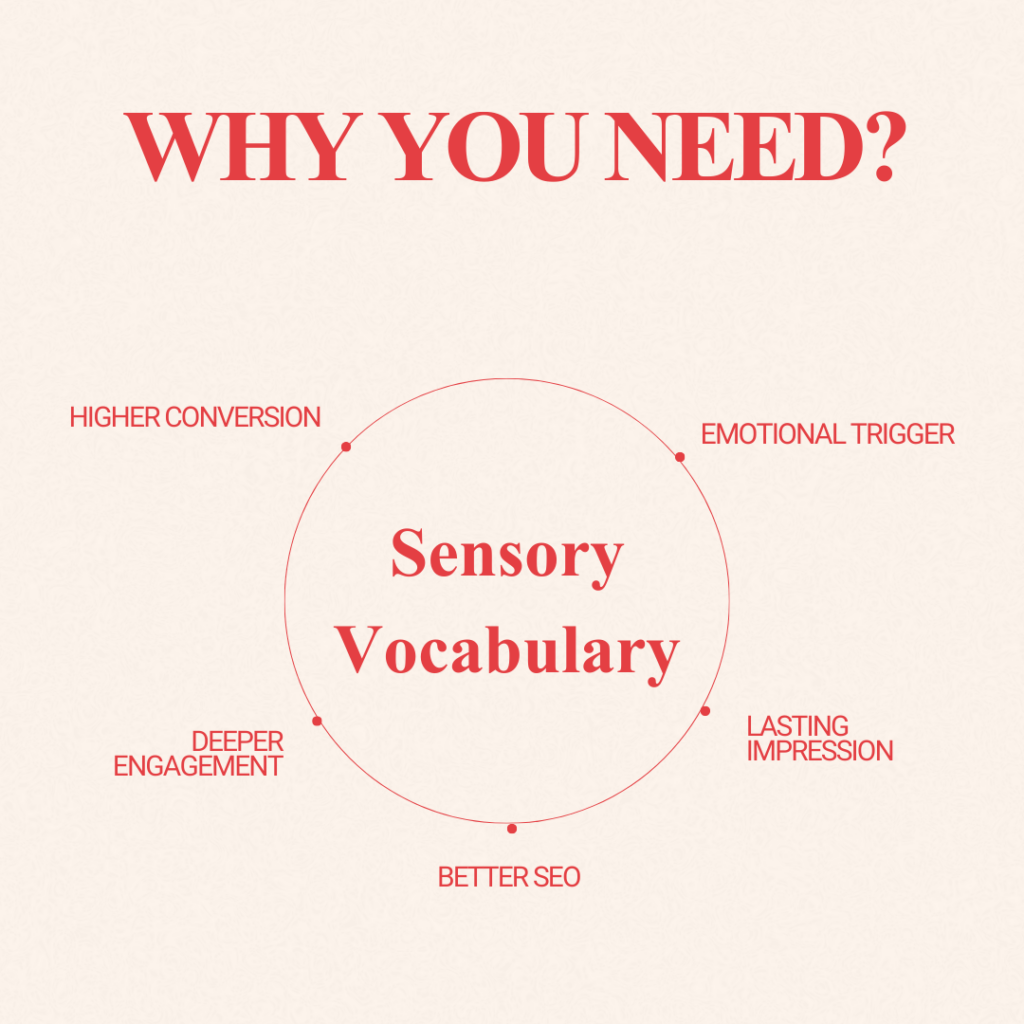
Emotional Trigger: Sensory words bypass the logical brain and tap directly into the reader’s emotions. By describing a feeling—like the stinging cold or a soothing breeze—you create an immediate, personal connection that facts alone cannot achieve.
Lasting Impression: Our brains are wired to remember experiences over data. While a reader might forget a list of statistics, they will remember a vivid description that allowed them to “live” the story through your words.
Higher Conversion: Sensory details help your audience visualize the benefits of a product or service. When they can “feel” the sleek texture or “hear” the satisfying click, they become much more likely to take action.
Deeper Engagement: These words act as “speed bumps” for skim-readers. They force the audience to slow down and immerse themselves in your content, which significantly boosts your overall dwell time and engagement.
Better SEO (Search Engine Optimization): While Google doesn’t rank you for specific adjectives, sensory words increase Dwell Time (how long people stay on your page). High dwell time signals to search engines that your content is valuable, helping you rank higher in search results.
How to Actually Apply Sensory Vocabulary to Your Writing
Knowing the words is one thing; knowing how to use them without making your blog feel “crowded” is the real skill. Here is a simple 3-step process to upgrade your drafts:
1. Perform a “Sense-Check” on Your Drafts
After writing your first draft, go back and look for “flat” adjectives like good, big, nice, or bad. Ask yourself: “Can I replace this with a sensory detail?”
- Instead of: “The market was busy.”
- Try: “I navigated through the vibrant market, where the scent of aromatic spices filled the air.”
2. Focus on One “Anchor” Sense
You don’t need to use all five senses in every paragraph. Instead, choose one “anchor” sense that best fits the mood.
- For a cozy cafe review: Focus on Smell (freshly ground beans) and Touch (the warmth of the mug).
- For a tech product review: Focus on Sight (the sleek, matte finish) and Sound (the satisfying click of the keys).
3. Use the “Show, Don’t Tell” Rule
Sensory vocabulary is the best tool for this golden rule of writing. Instead of telling the reader how you felt, use sensory words to show them.
- Don’t tell: “I was nervous.”
- Show: “My palms felt clammy, and I could hear the thumping of my heart in the silent room.”
Frequently Asked Questions (FAQ)
Q: Should I use sensory words in every single sentence?
- A: Definitely not. If you overdo it, your writing will feel cluttered and heavy. Use them strategically—like in your introduction to grab attention, or when describing a key product feature to make it stand out.
Q: Are sensory words appropriate for technical or professional blogs?
- A: Yes, but keep it subtle. Instead of poetic descriptions, use professional sensory adjectives like “crisp display,” “seamless integration,” or “robust architecture.” This makes abstract concepts much easier to “see.”
Q: How can I find more of these words if my vocabulary is limited?
- A: Use a thesaurus or practice “mindful observation.” Instead of writing “the coffee is good,” stop and ask yourself: Is it earthy, nutty, or smoky? Real-life observation is the best word bank.
Q: Does using sensory vocabulary help with SEO?
- A: Indirectly, yes! While Google doesn’t rank you just for using the word “velvety,” these words increase Dwell Time (how long readers stay on your page). When readers are “immersed” in your story, they stay longer, which signals to Google that your content is high quality.
Conclusion
Mastering Sensory Vocabulary is the fastest way to bridge the gap between your screen and your reader’s imagination. By shifting from “telling” to “showing,” you transform a simple blog post into an unforgettable experience.
Next time you write, don’t just reach for generic words. Ask yourself: What does this moment truly feel like? Add a few sensory touches to your next draft and watch your reader engagement soar.